



You’ve built a website that says “come as you are.” You’ve written warm captions, picked welcoming fonts, put real thought into how your church comes across online. That work matters, and it’s doing its job.
But brand doesn’t stop at the homepage. It’s also the version of your church that shows up on an ordinary Tuesday, in a stretched staff meeting, in whether a volunteer gets thanked or overlooked.
A church’s brand isn’t a marketing checklist sitting off to the side of ministry. It’s part of how a community decides whether to trust you with their story, their kids, and their Sunday mornings. When you get this right, you clear the way for people to encounter Jesus without confusion.
We sat down with Spencer Passwater, Director of Brand Squad at Church Media Squad, who has served on church creative teams himself, to talk about what happens when culture and brand don’t align, and what that gap costs churches.
Your Brand Goes Far Beyond the Logo
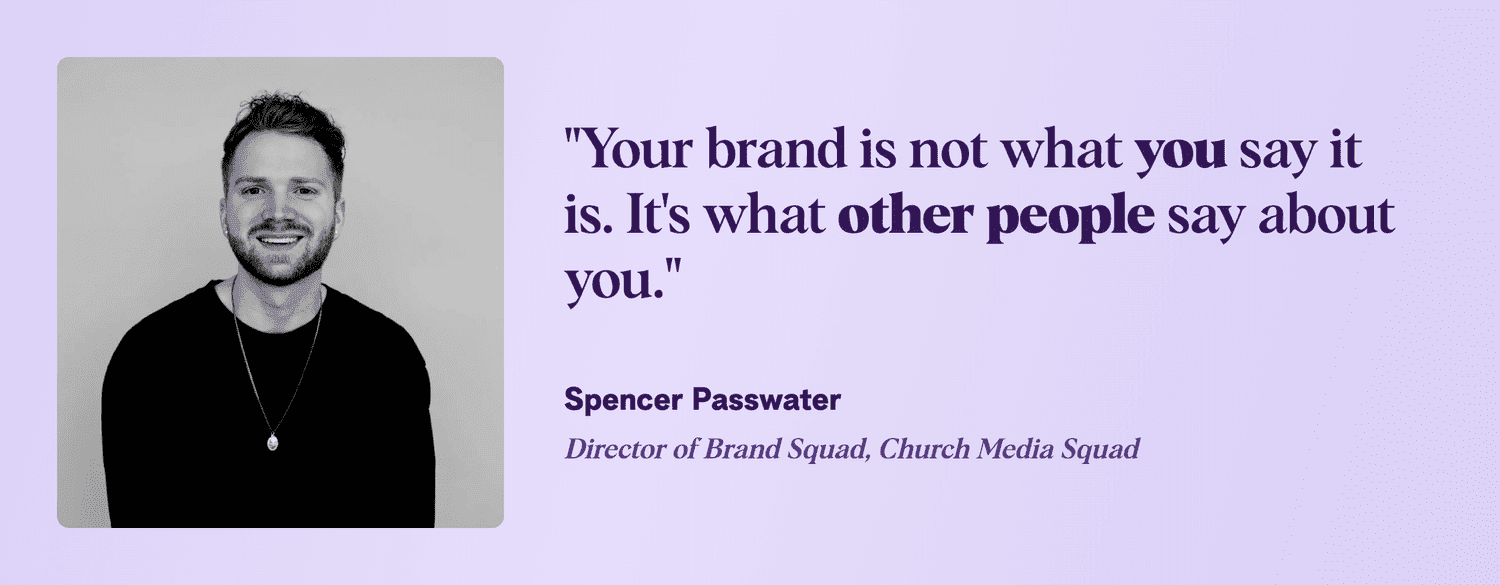
“Your brand is not what you say it is,” Spencer says. “It’s what other people say about you.”
“You could spend 30 seconds describing a church to me, or you could show me its logo, and I’ll know exactly who it is in a split second,” Spencer says. “The visuals have an important purpose and function, but the heart of the brand lies underneath the surface.” It’s the gut feeling someone gets while they shake hands in the lobby, sip the coffee, drop their kids off at check-in, and find a seat before worship starts. Enough people arriving at the same conclusion about your church, and that conclusion becomes your brand, whether you ever put it in a brand guide or not.
That might sound like your brand is out of your hands, decided entirely by other people. It’s not. “The decisions you’re making about your brand experience and the culture you’re fostering are influencing those opinions,” Spencer says.
The Tell: When the Vibe Doesn’t Match the Visuals
Spencer has walked into churches with safe, corporate-looking visuals that had far more life behind the scenes than their brand communicated. “Their greeters were warm and inviting, their worship was dynamic, their production was polished, and their sermon had me on the edge of my seat,” he says. None of that made it into the church’s public image.
He’s also seen the opposite: a distinct, well-designed brand paired with a culture that’s barely holding itself together. A couple of telltale signs: First, “how are their staff and volunteers doing? Are they burned out? Are they barely holding it together?” Second, is the church running someone else’s entire playbook? “If that church is in a different city or state and has 3 extra zeroes in its budget, is it wise to use their playbook?”
Ministry Moments: What Your Camera May Be Missing
“Any church will have cracks,” Spencer says. “We’re all imperfect people serving a perfect creator. If the lyrics aren’t perfectly in sync with the band, that doesn’t mean God won’t show up.”
The clearest signal of a church’s real culture shows up in its unscripted moments. “When I served on a creative team, we called them ‘ministry moments,’” Spencer says. “...A person in need who received prayer. A spontaneous baptism. A group of young adults who lingered in the lobby after service. You don’t need to rehearse those; you just let the Spirit guide you.”
Here’s his gut-check for creative teams: “If your recap photos are limited to the people who are paid to be in the building, something is wrong. ...What’s happening beyond the service flow you have in Planning Center?”
What Makes or Breaks a Rebrand
That same gap between culture and presentation doesn’t just show up in a Sunday recap. It shows up at scale, too, especially when a church attempts something as big as a rebrand.
A rebrand can only carry a church as far as its culture allows. Spencer’s seen rebrands stall for all kinds of reasons: leadership not on the same page, staffing changes mid-process, outside noise pulling focus. “I think the most successful brands are the ones with the strongest ambassadors,” he says. “If there’s unity behind the change and excitement among your staff, you have a good thing going.”
Spencer’s own church rebrand is proof, and it came with a surprising twist. “Someone took a picture of the logo, recreated it as best they could, put it on a t-shirt, and handed it out,” he says. “As creatives, we were panicking because it was not in line with our brand guide. Looking back, this was probably one of the coolest things that happened during our rebrand. People were actually excited about it! They were wearing our logo with pride, even though it was off-center.”
Brand Isn’t a Checkbox. It’s a Habit.
It starts at the platform, Spencer says. “If you’re a lead pastor reading this, you don’t need to know a thing about design to lead your rebrand,” he says. He extends that same logic to everyone else on staff: “If you’re on a church staff, your role matters to the brand, whether you know it or not. When there’s unity, the brand becomes so much clearer. And yes, a cool logo is the cherry on top.”
That unity is part of your culture, practiced on purpose, week after week. “I like to think of branding as a discipline,” Spencer says. “Those weekly rhythms matter. Consistency matters. Intentionality matters... we stay sharp, we focus on the details, and we push to be just a little bit better each day.” It’s not consistency for its own sake, either. “We respond to a higher calling and a greater mission,” he says. “We want to see more people reached, more lives transformed, and a community that rallies together.”
We’ve written before about why consistency matters more than your best graphic if your team needs a concrete starting point for building that discipline.
What the Brand-Culture Gap Costs You
“When there’s a gap, it can blind us to what’s really happening,” Spencer says. “People can get hurt by the church. Staff can get burned out. The church body can lose trust in leadership. The presentation might still be good, but we can miss out on the things that really matter most.”
That’s the real cost. Not a weaker Instagram grid or an inconsistent color palette. A slower erosion of the trust a church needs to shepherd people well, the kind of trust that lets someone take their next step toward Jesus. The stakes here go past marketing, straight to whether a church is caring well for the people it’s called to serve.
Closing the Gap: The First Step
Closing the gap starts with a few honest conversations, not a full rebrand. No spreadsheet required, no designer required. Just the willingness to ask, and to sit with the answers.
Try these this week:
- Ask your team: Describe your church in a sentence. Then ask whether your visual identity reflects that description. If enough people arrive at the same conclusion, that’s your brand.
- Ask a volunteer, a coworker, or even a stranger: What comes to mind when they see your logo? Their answer might surprise you.
- Pay attention to a normal Tuesday: Is your staff communicating with each other, or is everyone working on their own island?
- Start the harder conversations: What’s our mission? What kind of brand do we want to be? Where are we out of alignment?
Remember: Your Brand Can Grow With You
“The craziest thing you’ll hear a brand director say,” Spencer says, “is that some of the most successful church brands hardly ever use their actual branding. Your visual brand should never feel like a limit to your creativity. Aim for creativity first, then bring your visual brand along for the journey.”
If your team is ready to close that gap for real, that’s the kind of work we love helping churches with: full-service graphics, video, social media, and website support, paired with branding guidance built around who your church really is. Let’s talk about what that could look like for you. When your brand tells the truth about your church, it clears the way for people to see past the presentation and encounter Christ.
Want this handled for you?
Brand strategy, a logo, and a guide your volunteers can actually follow, so the slides in September still look like the slides in March.


Published by Church Media Squad on August 4, 2026.