



You put everything into that Easter series. The graphics were sharp, the stage looked great. It felt like a win.
Then May came. A new month, a new series, a new starting point. And somewhere between the holiday push and the weeks that followed, the church branding drifted. Nobody planned it. Nobody decided to change anything. But if you lined up the last twelve months of your church’s creative work, you might not recognize it as coming from the same place.
Many churches assume the answer is better design, a bigger budget, or a more talented team.
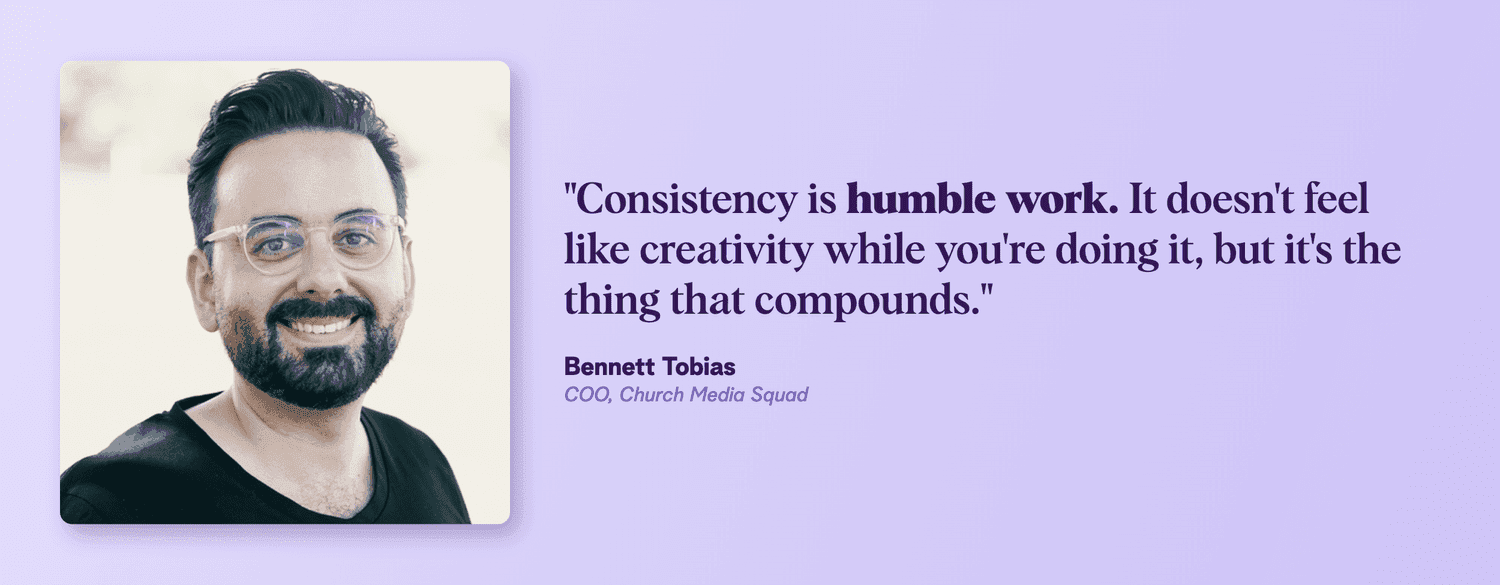
We sat down with Bennett, COO of Church Media Squad and a former church Creative Director, to talk about why consistency beats brilliance in church creative work, and what it takes to stop starting over every Sunday.
The One Thing Your Church Communications Strategy Is Missing
Before someone hears a sermon, before they meet anyone on staff, before they step through the doors, they’ve already formed an opinion about whether this church is worth a closer look. Your creative work is part of what shapes that opinion. Consistent, on-brand church media communicates that somebody here cares enough to show up well, week after week, for the people they’re trying to reach. That’s not a branding win. That’s a ministry posture.
For many people today, the first encounter with your church happens online. What they see either feels like one cohesive church or it doesn’t.
“Whatever you put out, an event promo, a sermon series, a weekend announcement, people can tell it came from you,” Bennett said. “The content changes every week, but there’s a thread running through all of it that feels like your church, and your people start to know that feeling without having to name it.”
What the Churches Building Something Have in Common
When Bennett looks at the churches that have built something recognizable, one thing shows up every time.
“The common thread is consistency,” he said. “For church creative especially, it matters more than intensity.”
These churches usually have someone steady running the look, a designer who knows the church inside out, or a coordinator functioning as a gatekeeper between staff requests and the designers filling them. There may not even be a formal brand guide. But there is a person who owns it.
“They care more about showing up than showing off,” Bennett said. “You’d recognize their work with the logo cropped off. By how it looks and how it makes you feel.”
Practical question to ask your team this week: If someone covered your church’s logo on your last five posts, would they still look like they came from the same place? If the answer is no, that’s a good place to start.
What the Warning Signs Look Like
The churches chasing the occasional great piece instead of consistency are easier to spot than they’d like to think.
Every series looks like it came from a different church. There’s a big push before Easter, then long stretches of whatever-was-fastest. The team is proud of individual pieces, but nobody can describe their church visual identity in one sentence, and the bar shifts with whoever made it that week.
“A first-time guest who shows up at Easter gets your best week, then comes back in May to something that looks nothing like it,” Bennett said. “You set the expectation on the one Sunday you went all out, and the normal week can’t live up to it.”
The people in the seats aren’t grading the craft. What they notice is whether it all feels like one church, week after week, or a different one every time.
“Nobody remembers your best graphic, but everybody feels it when the work drifts,” Bennett said. “You’re starting from zero every Sunday.”
And when nothing carries over, the mission pays the price.
“Consistency is the lever most churches are missing,” Bennett said, “and it’s the one you don’t need a bigger budget to pull. Being recognizable is a decision. It’s choosing to show up the same way enough times that your people start to know you, and any church can make that choice.”
What Consistent Church Creative Does
People stop noticing the graphics and start trusting the church. A volunteer can step in on a hard week because the system carries the look instead of depending on one person’s taste. The communications director stops spending Sunday energy asking “does this look okay?” and puts it back on the message.
Over time, your people interpret consistency as care. It registers when someone is deciding whether to come back, and it registers before they’ve said a word to anyone on staff.
“The trust goes further,” Bennett said, “because it tells people you take the message seriously enough to do it right.”
Where the Pressure to Chase “Great” Comes From
“Mostly comparison and ego,” Bennett said. “Church designers aren’t immune to either. Whether it’s the church across town or a designer whose instinct is to build a portfolio, the bar starts drifting toward wow. What a church is after is trust, and trust doesn’t come from one stunning piece. It comes from doing it the same way enough times that people stop wondering and start belonging.”
What Church Brand Consistency Requires
Less than most people think. But it has to be decided and written down.
Bennett’s framework: don’t lower the bar, narrow it. A short set of rules, not a sixty-page guide nobody opens. A few templates you reuse instead of building from scratch. One person who owns the look for your church communications.
His rule for sustainability: build for your worst week, not your best one. “The bar should be something a tired team on a bad week can still clear, because the bad weeks are the ones that decide whether you’re consistent or just occasionally great.”
He learned that the hard way as a church Creative Director.
“I spent real energy swinging for home runs, and the win was singles,” he said. “The graphic I poured hours into, or the Christmas stage set everyone raved about, got the compliment in the moment and then it was gone. The consistent stuff I almost resented doing is the part that actually built trust with the people in the seats.”
More often than not, when churches struggle to hold that bar week after week, it’s not a talent problem. It’s a capacity one. Holding a professional bar every week, without running your one capable volunteer into the ground, is the part many churches find hardest. But it’s also where simple systems can make a real difference.
What You Can Do This Month
Lock your fonts and colors, then build a template for the one or two things you put out every single week. For most churches, that’s the sermon graphic, the announcement slides, or a standard social post.
“A template is a frame, not a cage,” Bennett said. “The content inside it changes every week. The series changes, the photos change, the message changes. But the frame keeps it all reading like one church.”
Start with one template if three feels like too much. Stay consistent with the look for a month. One small, repeatable thing held for thirty days will teach your church creative team more about consistency than any rebrand.
For the longer haul, the most important thing you can do is pin down your church’s feel in words. Sit down with a couple of people who know your church and finish this sentence: When someone runs into us, online or in person, we want them to feel ___. Pick two or three words that are true of you. Use those words as a filter before anything goes out. Does this feel like that? If it doesn’t, it goes back.
Once the feeling has words around it, you can build real rules around it, and your whole team has something to aim at when the week gets hard. If you haven’t done the work of defining your church’s creative voice yet, this is a good place to start.
Try it this week: Block 30 minutes with one other person. Write the sentence. Pick the words. Put them somewhere everyone can see them.
What Gets Lost When Church Media Feels Generic
“You forfeit recognition, and nothing accrues,” Bennett said. “Every piece starts over instead of adding to a body of work people already trust.”
Your church communications are part of how someone decides whether this place is solid, cared-for, and worth a second look, before they’ve heard a word from the stage. A church whose creative work feels unmistakably like itself tells people somebody here pays attention.
“Work with people you trust, who learn your church and protect its feel like it’s their own,” Bennett said. “Because in the end, trust is the front door. It’s what lets a stranger feel safe enough to walk in, and a regular feel proud enough to bring a friend.”
Want this handled for you?
Brand strategy, a logo, and a guide your volunteers can actually follow, so the slides in September still look like the slides in March.


Published by Church Media Squad on July 9, 2026.