



If you're like most church video teams, your crew fits in a compact car. It's you, one volunteer who knows how to plug in an HDMI cable, and maybe a high schooler who's "good at TikTok."
You're expected to produce Sunday service recordings, promotional videos, testimony clips, and social media content, all while running on fumes with a limited budget. More people would help, sure. But what if the answer isn't adding bodies but working smarter with who you already have?
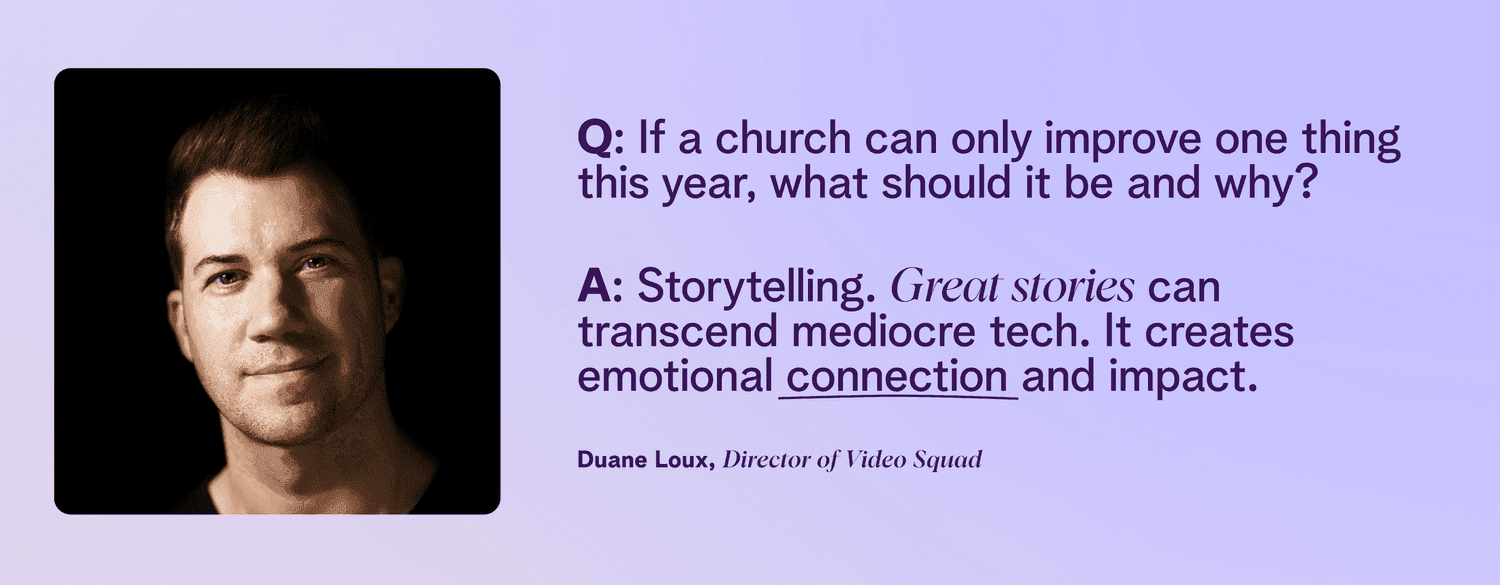
We sat down with Duane Loux, Director of Video at TheSquad, to get answers about what matters when your team is maxed out.
Every video you create is an opportunity for someone to encounter the gospel. A sermon clip could reach someone who'd never walk through your doors. When your videos honor the message and the moment, they become tools for kingdom impact, not just content to check off your list.
First Things First
Here's a simple truth that might save you thousands of dollars: Your camera isn't your problem.
You've been eyeing that new Sony or Canon, thinking that's what separates your videos from the polished content you see online. But there’s a better way to make a noticeable impact on your video production.
Here are three things you should focus on first:
- Audio. Get a solid wireless lav mic or shotgun mic setup.
- Lighting. A $100 softbox light will do more for your perceived production quality than a $3,000 camera upgrade.
- Consistency. Find one shot, one setup that works, perfect it, and repeat it with excellence.
The churches that look polished aren't constantly experimenting with new angles every week. They've dialed in their formula and execute it well every single time.
Stop Overcomplicating It
The biggest trap we see churches fall into is buying expensive equipment they don’t even know how to use. While you’re fumbling with your camera settings, you’re missing an opportunity to capture a powerful moment of God at work in your church.
Fancy isn't better if you don’t know how to use it.
The fix is to set up a few high-impact repeatable templates. Using equipment that you already know how to use (even if it’s an iPhone!), create preset shoot setups with consistent camera settings, lighting positions, and framing techniques. Know your go-to angles for Sunday services, testimonies, and promos. Dial in your color and exposure settings once, then save them.
Consistency equals quality. Simplicity done well beats complexity done poorly every. single. time.
Your Minimum Viable Setup
Here's Duane's setup that gets you professional results without breaking the bank:
The Shopping List:
- Camera: Sony ZV-E10, α6400, or similar mirrorless ($600-900)
- Audio: Rode Wireless GO DJI Mic 2 plus backup recorder ($200-300)
- Lighting: Godox SL60 with large softbox, 80-120cm ($150-250)
- Lens: Sony FE 50mm f/1.8 or Sigma 18-50mm f/2.8 ($200-500)
- Tripod: Solid and stable ($100-200)
- Backdrop: Clean, uncluttered space or interesting room like your lobby (free)
Total investment: $1,500-$2,500. That's probably less than what your youth group spends on pizza for the year…and this gear will serve your ministry for years.
What you don't need yet: A fleet of cameras, cinema-grade gimbal, that $4,000 lens, or drone footage. Save your budget for what moves the needle: audio and lighting.
Film Once, Use Everywhere
If you're only using that testimony video once, in one service, you're leaving kingdom impact on the table. Your small team doesn't have time to film new content every day, so stop treating each piece as single-use.
Get the most out of your content by:
- Filming in widescreen that works as vertical (frame for both 16:9 and 9:16)
- Shoot in 4K if possible for flexibility to crop while maintaining quality.
- From every shoot, create long-form for YouTube, 60-second highlights for Instagram, 15-second teasers for Stories, and still frames for quote graphics.
While you're set up for that interview, capture extra b-roll, wide shots of the environment, and close-ups for transitions.
If you want to take it a step further, build your content around seasonal rhythms. Easter, Christmas, Fall kickoff. You know they're coming, so do future-you a favor and plan ahead. Build a content bank by filming interviews, testimonies, and b-roll ahead of time and on a schedule. We say this with love, but the churches that have it together aren't filming everything the Friday before it's due.
Setting Up Volunteers to Win
Throwing volunteers into the deep end with no training, no clear expectations, and no idea what success looks like kills video teams faster than anything else. That eager volunteer shows up ready to serve the kingdom, you hand them a camera and say, "just film the service," and then everyone's confused when the footage is unusable. Try this framework when onboarding your next volunteer:
Step 1: Train them (even just a little)
Give new volunteers 30 minutes to walk through your setup, settings, and what good footage looks like. It doesn't need to be a semester-long course, just enough to build confidence.
Step 2: Pair them with someone experienced
Create a buddy system where new volunteers shadow seasoned ones for a week or two before going solo. Mentoring catches mistakes before they happen.
Step 3: Start with small, achievable wins
Don't ask someone to run three cameras on their first Sunday. Start them with one clear job: "Your only task today is to monitor audio levels." Success builds confidence, and confidence builds commitment.
Step 4: Give them documentation they can rely on
Create laminated cheat sheets with camera settings and setup/teardown checklists. When volunteers don't have to guess or remember, they can focus on serving well.
Step 5: Celebrate and define wins
Thank volunteers publicly and tell them specifically what they did well. Define what success looks like so they're not left assuming they're failing. ("If we get clean audio and steady shots, that's a win.")
When you invest in setting volunteers up for success, they'll surprise you with their commitment and growth, because they know their work matters for reaching people.
How to Measure What Matters
Views and likes don't tell you if your video ministry is working.
Better questions to ask:
- Did it move someone to action?
- Did someone show up to serve or take a next step in their faith journey?
- Did more people sign up to be kids camp volunteers?
- Did the recap video honor the experience and make participants feel seen?
These questions matter more than metrics, but you'll only improve if you're willing to learn from what you create. The churches that make the most impact build a culture of learning without blame.
Here’s what this might look like in your church: After every major shoot, you ask two simple questions. What worked, and what didn't? From there, you can decide what to do differently. When you create space for honest feedback without making it personal, your team gets better every single time. It’s not about criticism, it's about stewarding your ministry well and honoring the stories you're telling.
Start With One Thing
We’re not expecting you to have all of this tidied up by Sunday. Start with just one thing from this post. Maybe it's investing in better audio, creating a shot list, setting up a volunteer buddy system, or filming your next testimony with distribution in mind.
Start there, do it well, then pick the next thing.
The only thing standing between your church and video content that moves people toward Jesus might be a better system.
Your people are waiting to be moved by the stories you're capturing. The hope of Jesus should be shared with excellence, and that starts with clarity on what moves the needle and the courage to let go of what doesn't.
Ready to create high-quality video content without adding to your workload? Our Video Squad specializes in helping churches tell their stories well, even with limited teams and budgets. Talk to our team about video services for your church.
Want this handled for you?
Bumpers, promos, testimonies, and the vertical cuts that come out of a single Sunday service.


Published by Church Media Squad on January 20, 2026.